Part 1: The Heritage of Humanity – Why the Continuum is Our Compass
We live in a world that is developing faster than our biology can keep up with. While we have technologically arrived in the age of Artificial Intelligence and the speed of light, the heart of a hunter-gatherer still beats in the chest of our newborns. Our DNA has barely changed in the last 10,000 years, yet our living conditions are unrecognizable. We sleep in isolated rooms, measure love in strict schedules, and often wonder why we feel so empty, exhausted, or alienated despite material abundance.
Jean Liedloff observed something among the Yequana Indians in the jungle of Venezuela that she called the „nurturing soil“ of our human nature: The Continuum. It is the realization that we are born with a biological horizon of expectations that has grown over millions of years.
The Expectation of the Genes: An Ancient Blueprint
Every baby comes into the world with a backpack full of expectations. These expectations are not „spoiled,“ „tyrannical,“ or a product of modern indulgence; they are ancient and essential for survival. A newborn does not „know“ biologically that it is lying in a safe crib in a monitored new building. In its world of instinct, the absence of physical contact means mortal danger from predators or cold.
- Physical contact: A newborn instinctively expects to be placed directly on the mother’s bare body after birth.
- Sensory saturation: It expects the familiar scent of skin, the rhythmic swaying of walking, and the gentle murmur of human voices.
- Not an isolated object: In the Continuum Concept, we understand that a child is not a separate object to be „cared for“ or „fed“ in isolation. It is part of a flowing, living process.
When these archaic expectations are met, what psychology calls primal trust (Urvertrauen) is created. The child learns: „I am welcome. My signals are heard. The world is a safe place“. If these experiences are missing—for example, through long periods of lying in lonely rooms or intentional „crying it out“ for supposed self-regulation—a biological shock occurs. The child learns in its most formative moments: „The world is not safe“.
The Phases of Being: Why We Often Disrupt Development
Liedloff divides early life into phases that we today often artificially interrupt or try to replace with artificial stimuli (plastic toys, flashing screens):
1. The In-Arms Phase: Here, the baby is constantly carried. It participates in life without, however, being the continuous center of attention. It experiences the world from the safety of the parental body. It learns through observation of social interactions, not through active instruction or educational games.
2. The Exploration Phase: As soon as the child can crawl, it begins to move away on its own. Because its „safety tank“ is completely full due to the intensive carrying in the first phase, it possesses the courage and curiosity to discover the world on its own.
3. Social Integration: The child naturally wants to cooperate and be useful. In the continuum, there is no „upbringing“ through punishment, threats, or manipulation, but exclusively through leading by example within the community.
The True Value of „Passivity“
A common misunderstanding of the Continuum Concept is the belief that one must constantly entertain or actively „promote“ the child. However, the actual value lies in simple belonging. Having the child on one’s body while doing chores, cooking, or working teaches it more about real life than any educationally valuable toy. It experiences the deep truth: „I belong. I am right. I am not a disturbance“.
Part 2: The Harvest of Acceptance – Why the Continuum Makes Life Easier
When we understand the continuum, we realize that many „problems“ of modern upbringing—from sleep disorders to tantrum phases—are often self-made because we work against the nature of the child. The advantages of integrating this concept into our modern world are monumental.
1. Emotional Autarky instead of Constant Neediness
The greatest paradox of the continuum is: the more closeness a baby experiences, the more independent the child becomes later on. Many parents fear „pampering“ their child by carrying them too much. The reality is the opposite: a child whose need for closeness was completely saturated in the in-arms phase does not have to fight for attention later through whiny behavior or excessive clinginess. It possesses an inner foundation of gold. It knows that help is there when needed—and exactly this security gives it the freedom to let go.
2. Intuitive Cooperation instead of Grueling Power Struggles
The Continuum Concept assumes that children have an innate social drive. They want to do what the adults do; they want to be part of the „team“. When we stop seeing the child as an opponent to be „tamed“ or „broken“ and instead understand them as a competent partner, the classic power struggles disappear. The advantage is a relaxed togetherness in which the child helps out of inner motivation instead of fear of punishment or greed for reward.
3. Relief for Parents: Back to the „Village“ Effect
Liedloff shows us that we often put too much pressure on ourselves to be „entertainers“ for our children. The continuum frees us from this burden. We don’t have to sit on the rug all day stacking blocks when we actually have other tasks. We simply take the child with us into our daily lives. Parents thus retain their own identity and integrity. The child, in turn, learns that life consists of work, rest, and community—and not just an artificially created, child-centered world of entertainment.
4. Resilience and Unshakeable Self-Confidence
In this unconditional acceptance lies the actual power source of the child’s psyche. A child who experiences that its signals (crying, searching, cuddling) are understood and answered immediately develops an extremely high sense of self-worth. It learns that its needs are legitimate. This is the best prevention against later peer pressure, addiction risks, or toxic relationships because the child possesses an inner compass for „right“ and „wrong“.
Part 3: Building Bridges – The Continuum in the 21st Century
Of course, we can no longer live like the Yequana in the jungle today. We have jobs, appointments, and an infrastructure designed for separation rather than closeness. But we can use the principles and translate them into our modern context:
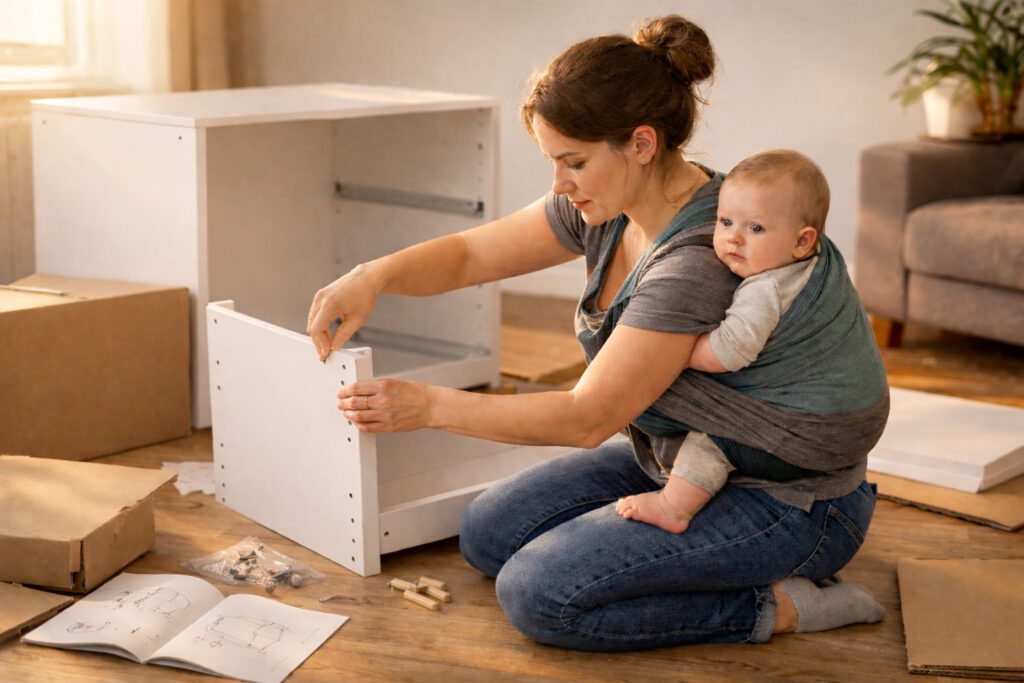
- Carrying instead of Pushing: A baby wrap enables the child to have the in-arms phase while the parents have their hands free for everyday life.
- Family Bed instead of Isolation: Sleeping together fulfills the nightly need for security and regulates the child’s nervous system.
- Trust instead of Control: We can trust that the child wants to develop without us constantly having to „promote“ or correct them.
Why the Continuum Saves Us Today
In a time of increasing psychological stress, Jean Liedloff’s approach offers a return to the essentials. It is not about being perfect, but about taking the biological needs of our offspring seriously again. The benefits are a deep, almost wordless connection to our children and the certainty that we are giving them the most valuable gift there is: The feeling of being welcome in this world.
When we have the courage to meet a baby’s cry not with a stopwatch but with our arms, we not only heal the connection to our child—we also heal, to some extent, our own often neglected nature. In a time when we are flooded by guidebooks, apps, and tables, the continuum calls us to look up from the screen and trust our child—and our own gut feeling—once again.